
Medieval to Early Modern Wax Seals
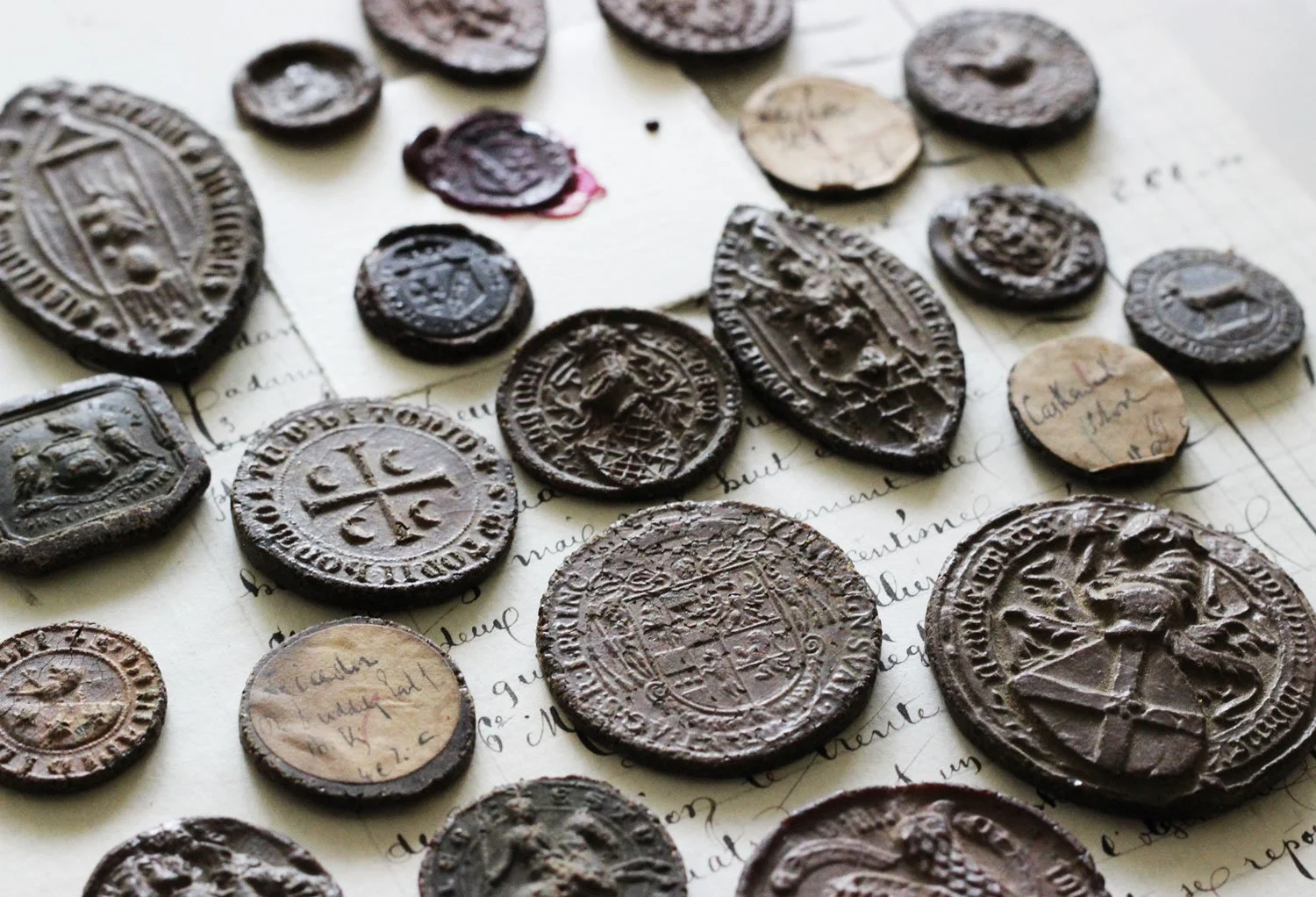
My collection of wax seal impressions from the medieval through 18th century.
The Art of Identity, Authority, and Authentication
Long before signatures became commonplace, a blob of colored wax impressed with a carefully carved seal served as one of the most trusted forms of authentication in Europe. From medieval monasteries and royal courts to merchant guilds and private households, wax seals conveyed authority, protected correspondence, and revealed something about the person or institution behind the document. They were practical legal devices, but they were also miniature works of art rich in symbolism and craftsmanship.
Between the twelfth and seventeenth centuries, wax seals evolved from relatively simple marks of identity into elaborate personal emblems reflecting rank, profession, family heritage, and even personal devotion. Today they remain among the most fascinating survivals of medieval material culture, preserving countless images of the people and institutions that shaped the Middle Ages and Renaissance.
How Wax Seals Came About
The practice of sealing documents is far older than medieval Europe. Ancient Mesopotamians used carved cylinder seals around 3500 BC, while the Romans authenticated documents with rings engraved with distinctive designs. Following the fall of the Roman Empire, written administration declined in much of Western Europe, but by the eleventh and twelfth centuries, as literacy, government, and commerce expanded, seals became indispensable.
By the High Middle Ages, seals were recognized across Europe as legally binding forms of identification. Kings, bishops, abbots, nobles, merchants, universities, towns, and eventually ordinary landowners all possessed seals unique to themselves. Because many people could not write their names, a seal often carried more legal weight than a handwritten signature.
The Parts of a Wax Seal
Seal Matrix
The seal matrix was the carved object used to impress the wax. Most were made from bronze, brass, silver, or occasionally precious metals or carved gemstones. Some wealthy individuals owned several matrices for different purposes.
Impression
The impression refers to the finished image left in the wax after the matrix was pressed into it.
Legend
The inscription running around the edge of the seal is called the legend. Usually written in Latin during the Middle Ages, it identified the owner.
A typical legend might read:
SIGILLUM ROBERTI DE LACY
("The Seal of Robert de Lacy")
Device
The central image of the seal is known as the device. This could depict a coat of arms, saint, animal, occupation, religious symbol, or decorative motif.
Plica
On important parchment documents, the bottom edge was folded upward to create a reinforced strip called the plica, through which cords or parchment tags were threaded before the wax seal was attached.
Pendant Seal
Rather than being pressed directly onto the document, many official seals hung beneath it on silk cords, leather strips, or parchment tags. These are known as pendant seals and were especially common on royal charters.
What Was the Wax Made From?
Early medieval seals often used natural beeswax.
As seal-making became more sophisticated, the wax was mixed with ingredients such as:
Resin for hardness
Tallow or fats for flexibility
Pigments for color
The result was a more durable seal capable of surviving transport and long-term storage.
The Meaning of Seal Colors
Color often carried meaning, although customs varied across Europe.
Natural yellow beeswax
Common for everyday documents
Frequently used by monasteries and private individuals
Green wax
Often reserved for perpetual charters
Land grants
Royal privileges intended to last indefinitely
English monarchs frequently used green wax for charters whose legal force was intended to endure.
Red wax
Increasingly popular during the late medieval and Renaissance periods
Used for important legal and diplomatic documents
Eventually became the most familiar sealing color
Black wax
Occasionally used during periods of mourning
Sometimes seen on funeral or memorial documents
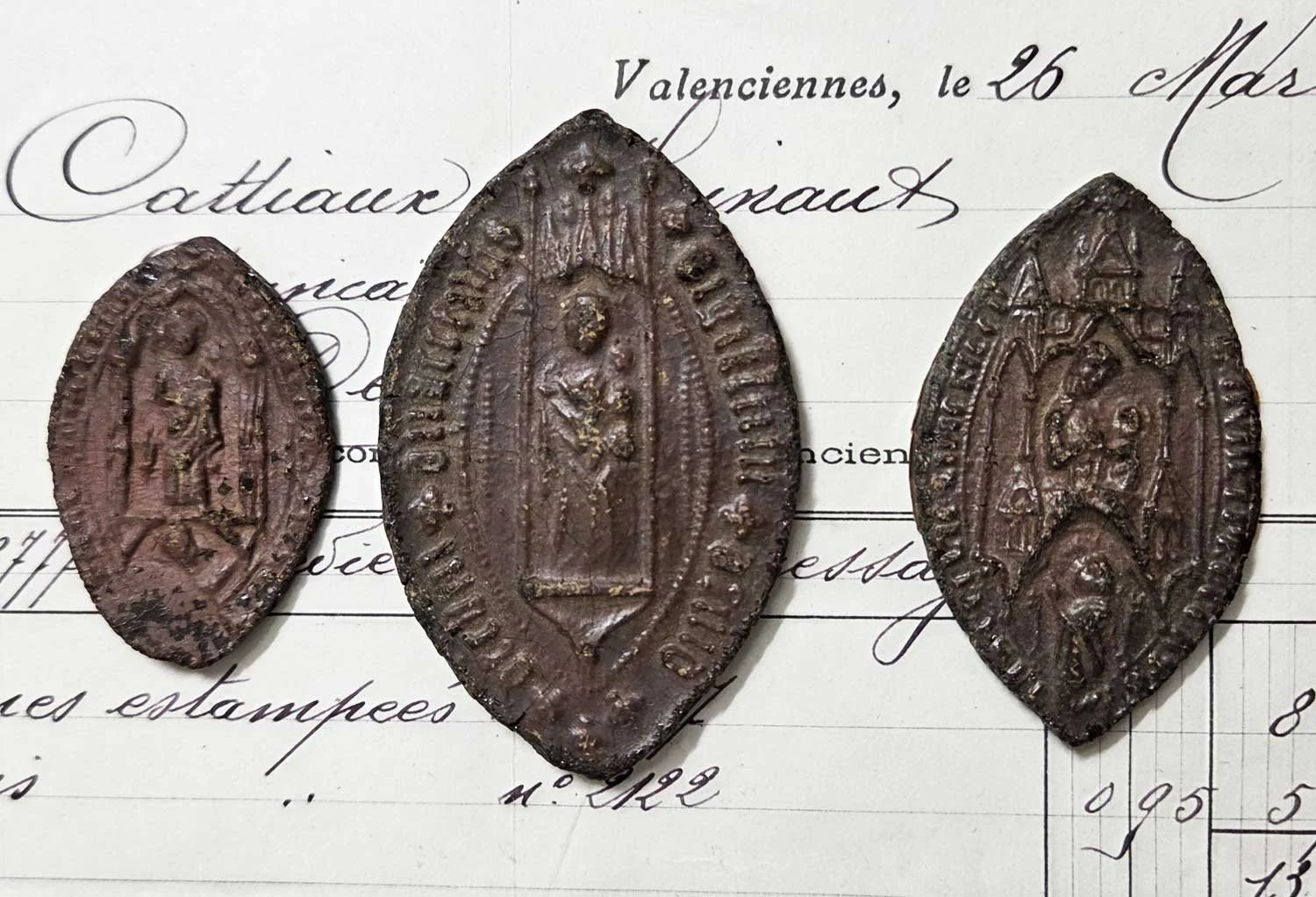
Ecclesiastical, pointed oval wax seal impressions.
Pointed Oval Seals: The Church's Distinctive Shape
One of the most recognizable medieval seal forms is the pointed oval, sometimes called the vesica piscis ("fish bladder") because of its elongated shape.
Unlike the circular seals favored by kings and nobles, pointed oval seals became closely associated with the Church.
They were commonly used by:
Bishops
Abbots
Abbesses
Cathedral chapters
Priors
Religious institutions
The vertical shape naturally accommodated standing figures.
Typical imagery included:
The Virgin Mary
Christ enthroned
Patron saints
Bishops holding croziers
Saints beneath Gothic architectural canopies
The pointed oval became so strongly associated with ecclesiastical authority that it could identify a church document even before its imagery was examined.
Royal and Noble Seals
Royal seals projected power.
Many monarchs possessed both a Great Seal for state business and a smaller Privy Seal for personal or administrative correspondence.
Common royal imagery included:
The ruler enthroned
Mounted on horseback
Wearing a crown
Holding orb and scepter
Displaying heraldic shields
These images emphasized legitimate authority and divine right.
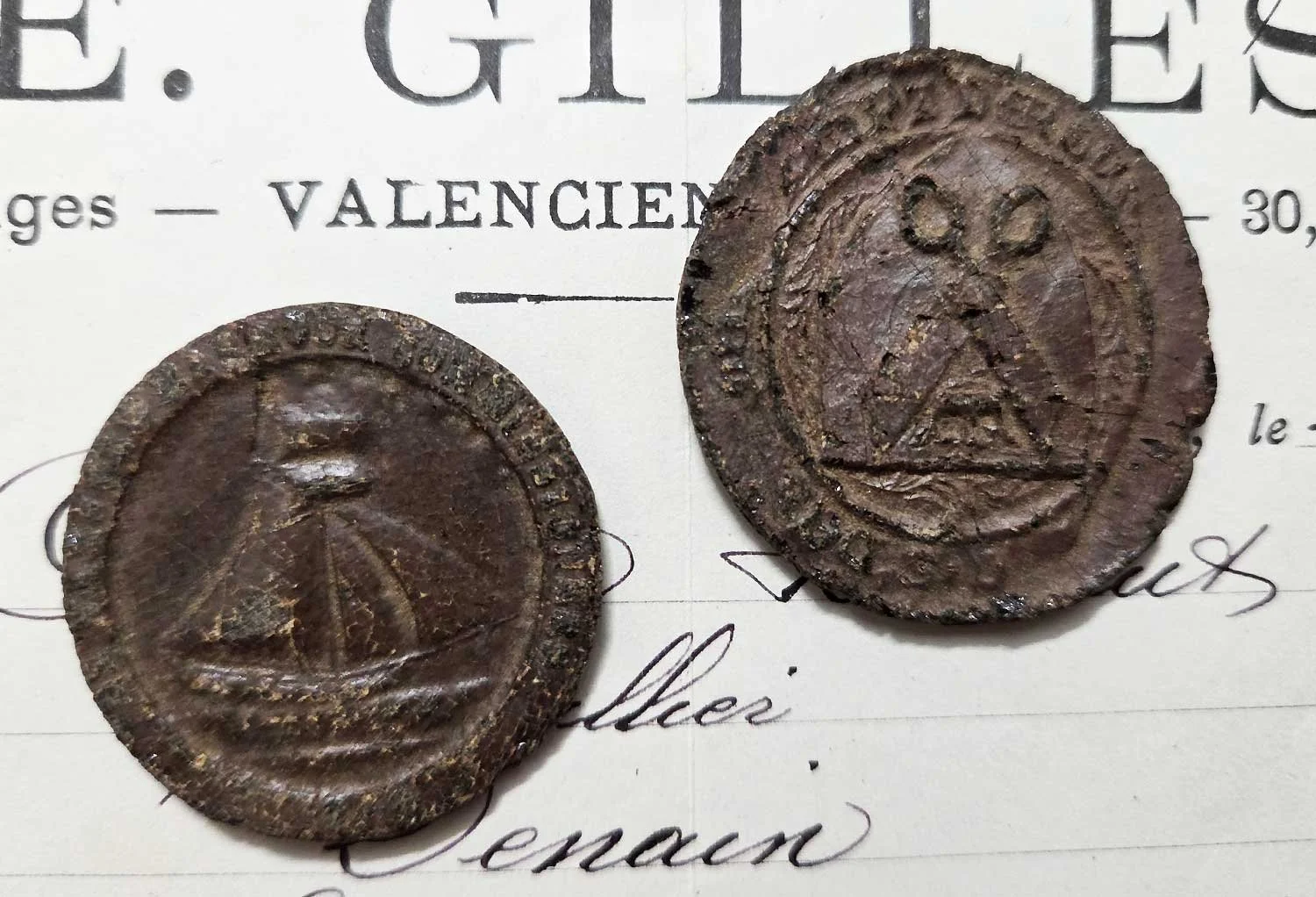
Ship and shears on seal imprints.
Occupational and Personal Symbols
Not everyone possessed a coat of arms. Merchants, craftsmen, physicians, and tradespeople frequently chose imagery reflecting their occupations.
Scissors or Shears, for example, for a tailor or clothiers, book, pen or scrolls for a Scribe or Notary. Ships, bales of cloth, scales, chests for a merchant, a Baker might have wheat sheaves or bread loaves. Blacksmith, a hammer, tongs, anvils, horseshoes. Masons were often represented by a compass, chisel, mallet. Goldsmith could have a chalice, rings or tools and a physician might have a mortan and pestle, plant ec.
Guilds also created communal seals depicting their patron saints or tools of their trade.
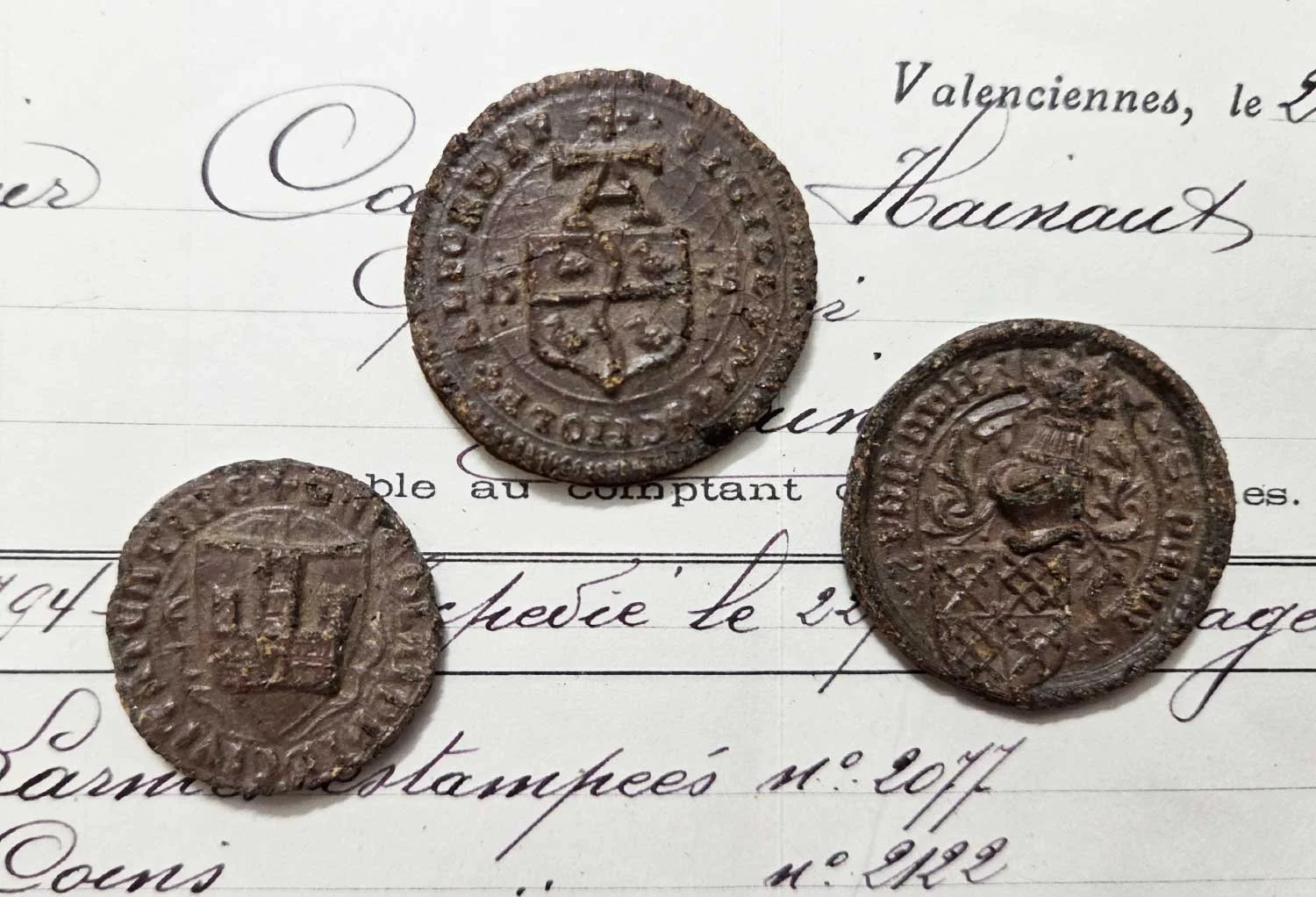
Medieval wax seal impressions with heralidc motifs and coats of arms.
These are some of my favorites as I love heraldic design. I think in order to read some of the legends, I might need to do a rubbing of them.
Heraldry on Wax Seals
By the thirteenth century, heraldic shields dominated noble seals.
These displayed:
Family coats of arms
Helmets
Crests
Supporters
Decorative mantling
For historians, seal impressions are often invaluable because they preserve early versions of coats of arms that may no longer survive elsewhere.
Women and Their Seals
Contrary to popular belief, many medieval women owned personal seals.
Queens, noblewomen, abbesses, wealthy widows, and female landowners used them to authenticate documents concerning property, inheritances, and legal agreements.
Their seals often featured:
Standing portraits
Family arms
Religious imagery
Floral ornament
Saints to whom they held particular devotion
Some women combined both their father's and husband's heraldry, illustrating family alliances and inheritance.
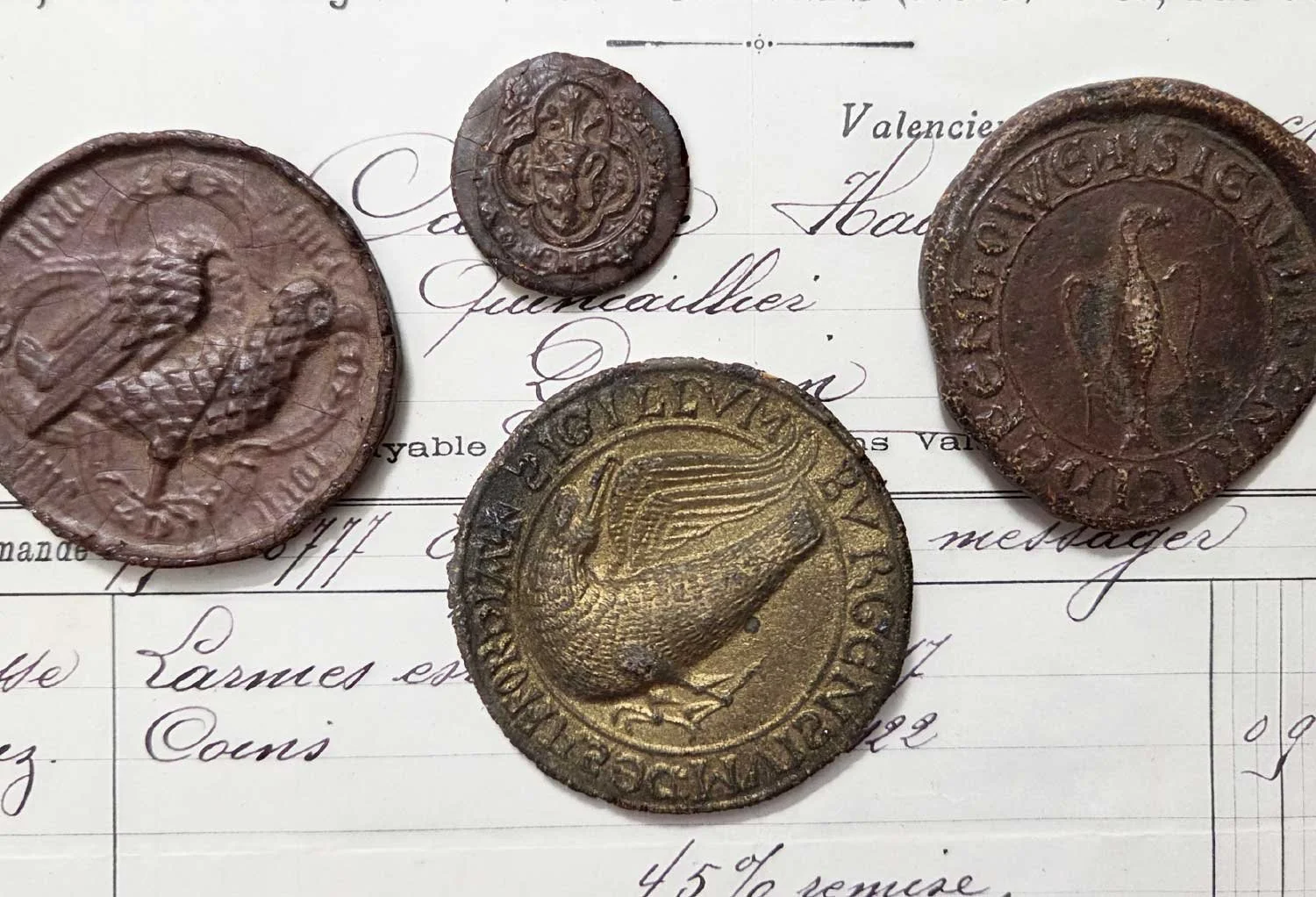
Medieval wax seal impressions with Lion Rampant and various birds.
I have to do a little research to identify these birds - on the back of the large one in the forefront, there is note written that it is a Seabird.
Saints, Animals, and Symbolism
Seal imagery often communicated personal identity beyond occupation.
Popular subjects included:
Lions for courage
Eagles for authority
Lambs for innocence
Pelicans symbolizing Christ's sacrifice
Griffins representing vigilance
Dragons signifying strength
St. George
St. Catherine
St. Michael
The Agnus Dei (Lamb of God)
Many people selected their patron saint as the central image on their personal seal.
How Documents Were Sealed
Several methods were used:
Wax pressed directly onto folded letters
Pendant seals suspended beneath parchment charters
Double-sided seals protecting both faces of the impression
Counterseals pressed into the reverse with a smaller matrix
Counterseals helped prevent tampering and added another layer of authentication.
Interesting Facts About Medieval Wax Seals
Many people were identified by their seal rather than their signature. Before widespread literacy, the seal served as a person's legally recognized mark.
Seal matrices were valuable personal possessions. They were often carried on a belt, suspended from a chain, or kept in locked chests.
Destroying a seal matrix was symbolic. Upon the death of a bishop or monarch, official matrices were sometimes deliberately broken to prevent fraudulent use.
Every impression was unique. Small differences in pressure, wax, and handling meant no two impressions were perfectly identical.
Some seals were enormous. England's royal Great Seal could measure over four inches (10 cm) across, while personal seals might be scarcely an inch (2.5 cm) in diameter.
Medieval seals preserve lost works of art. Numerous buildings, sculptures, coats of arms, and costumes known today survive only because they were depicted on seal impressions.
A Lasting Impression
To modern eyes, a wax seal may seem like a decorative flourish, but in the medieval and early modern world it was a declaration of identity, trust, and authority. Whether impressed by a king's Great Seal in rich green wax, an abbess's elegant pointed oval matrix, or a merchant's humble emblem of his trade, each seal carried a story about the individual or institution that created it.
Today, surviving wax seals continue to fascinate historians, genealogists, and artists alike. They preserve not only names and legal agreements but also an extraordinary visual record of medieval society—its professions, beliefs, heraldry, craftsmanship, and enduring appreciation for symbolic design. For anyone interested in the decorative arts, they offer a miniature gallery of medieval engraving and iconography, where every impression is both a work of art and a fragment of history.
I have had this collection of wax seal impressions for some time, on the back of many of them are a written description of the device and the family name they are attached to. Unfortunately, the text is written in script and quite small; although lovely, it’s hard to read.
In addition to these antiquarian impressions, I collect matrixes (stamps) and impressions from vintage and contemporary periods as well.