
Royal Whimsy and English Delftware
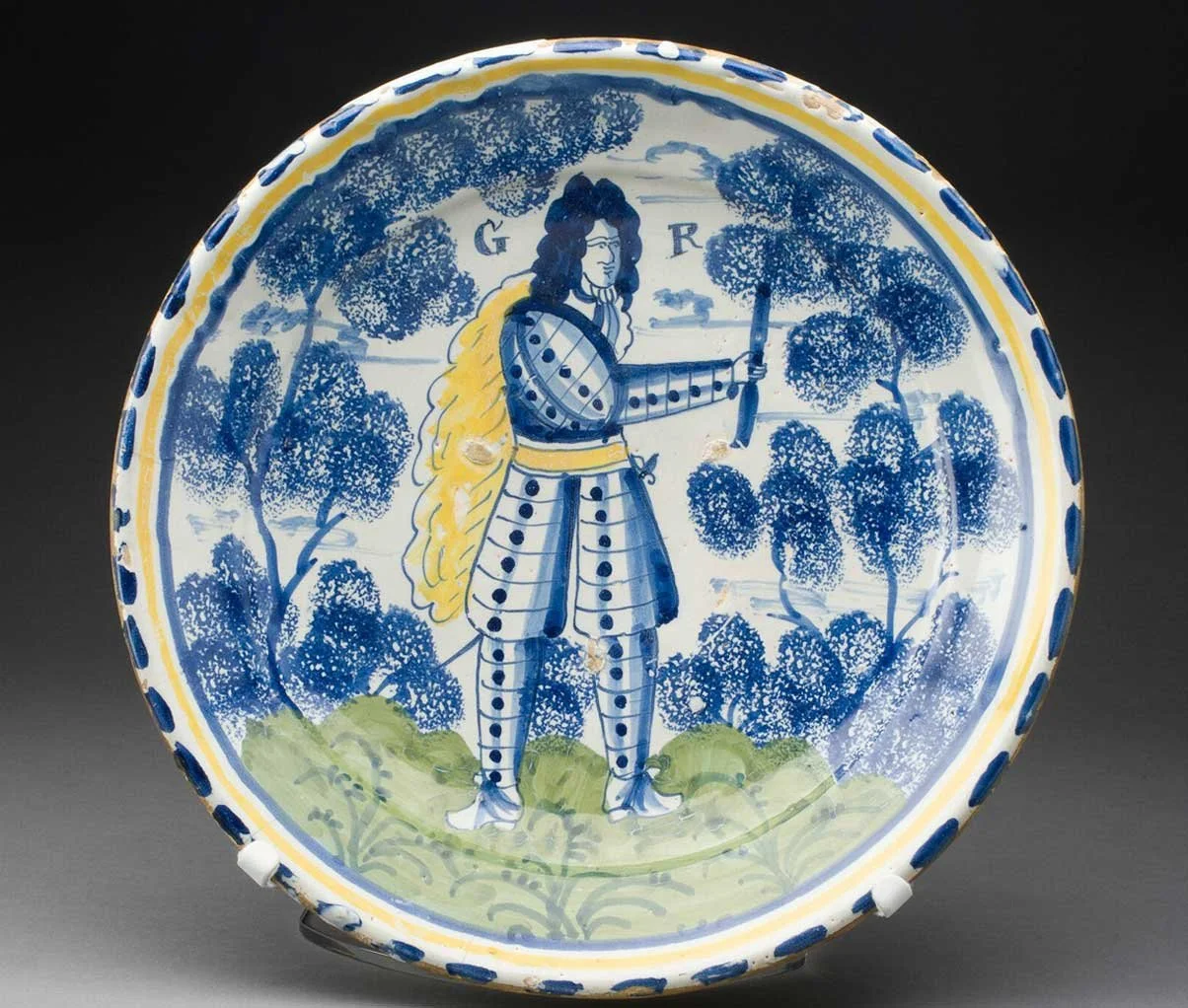
Tin-glazed earthenware and English Delftware captured the spirit and likeness of a royal age in 17th & 18th Century British Ceramics.
Above: 18th-century tin-glazed earthenware dish depicting King George I of England, now at the Art Institute of Chicago.
‘GR’ for Georgius Rex, King George.
Sometimes you don’t even realize you love something until you’re scrolling through photos taken over the years and you realize everytime you’ve gone to your local museum (in my case, the Art Institute of Chicago), you snapped a photo of the same object each vist. This was the case with Tin-Glazed Earthenware objects with royal depictions. In particulr, the Caudle Cup with King Charles II, which you will encounter a few paragraphs down.

King William on horseback, around 1700. Met Museum.
Before there was Porcelain in England there was…
Long before fine porcelain reached British shores in great quantities, a humbler but no less beautiful material graced the mantelpieces, tavern shelves and royal cabinets of England: tin-glazed earthenware. Fired low, coated bright white, and painted in vivid pigments, it was a technology that transformed common clay into something luminous and in England, it found some of its most enduring, whimsical and historically fascinating expressions in pottery celebrating the Crown.
What is Tin-Glazed Earthenware?
At its simplest, tin-glazed earthenware is pottery with a twist: the standard lead glaze, which fires transparent, is made opaque and brilliantly white by the addition of tin oxide ash. The result is a dense, ivory-white surface that accepts painted decoration with exceptional clarity. It’s almost like painting on paper. This quality made it the perfect vehicle for portraiture, heraldry, and the elaborate symbolic imagery beloved by monarchist culture.
The technique itself arrived in England in the mid-sixteenth century, carried by Flemish potters fleeing religious persecution in the Low Countries. They settled first in Norwich and then in London, establishing workshops in Southwark, Lambeth, and Bristol. Their product was, at first, barely distinguished from Continental wares. But over the following century, English potters developed their own vocabulary — looser, more painterly, and deeply entwined with the national moment.
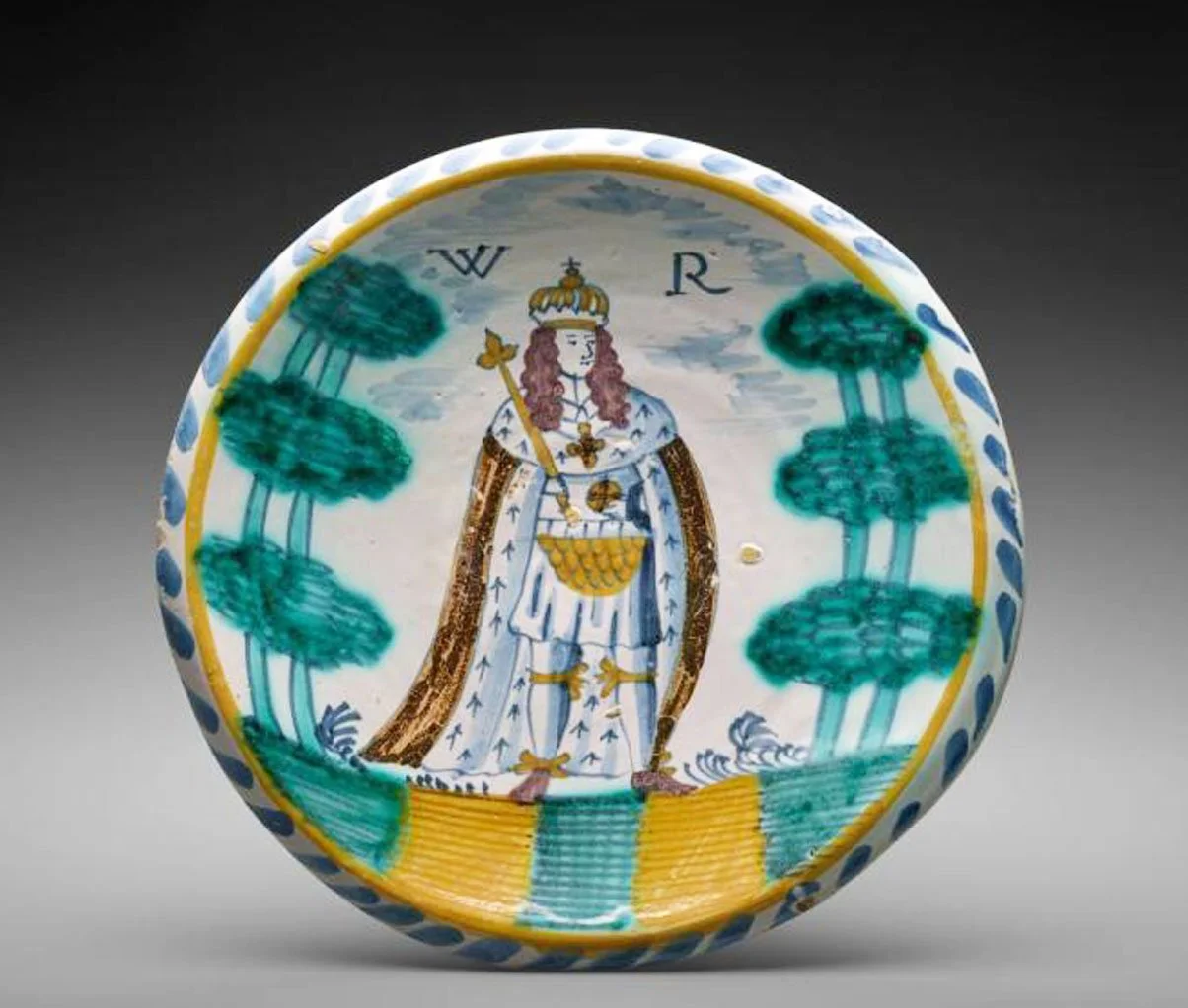
King William III, 17th century, English tin-glazed earthenware. Photo: Fitzwilliam Museum, Cambridge UK
The Rise of English Delftware
The term Delftware when applied to English pottery is technically a misnomer. True Delft comes from the Dutch city of Delft, which rose to ceramic dominance in the seventeenth century on the back of imported Chinese blue-and-white porcelain. When the Dutch East India Company flooded Europe with Ming wares, potters in Delft rushed to imitate the style. Their wares were so celebrated that the name stuck — even when the same style was produced in London, Bristol, or Liverpool.
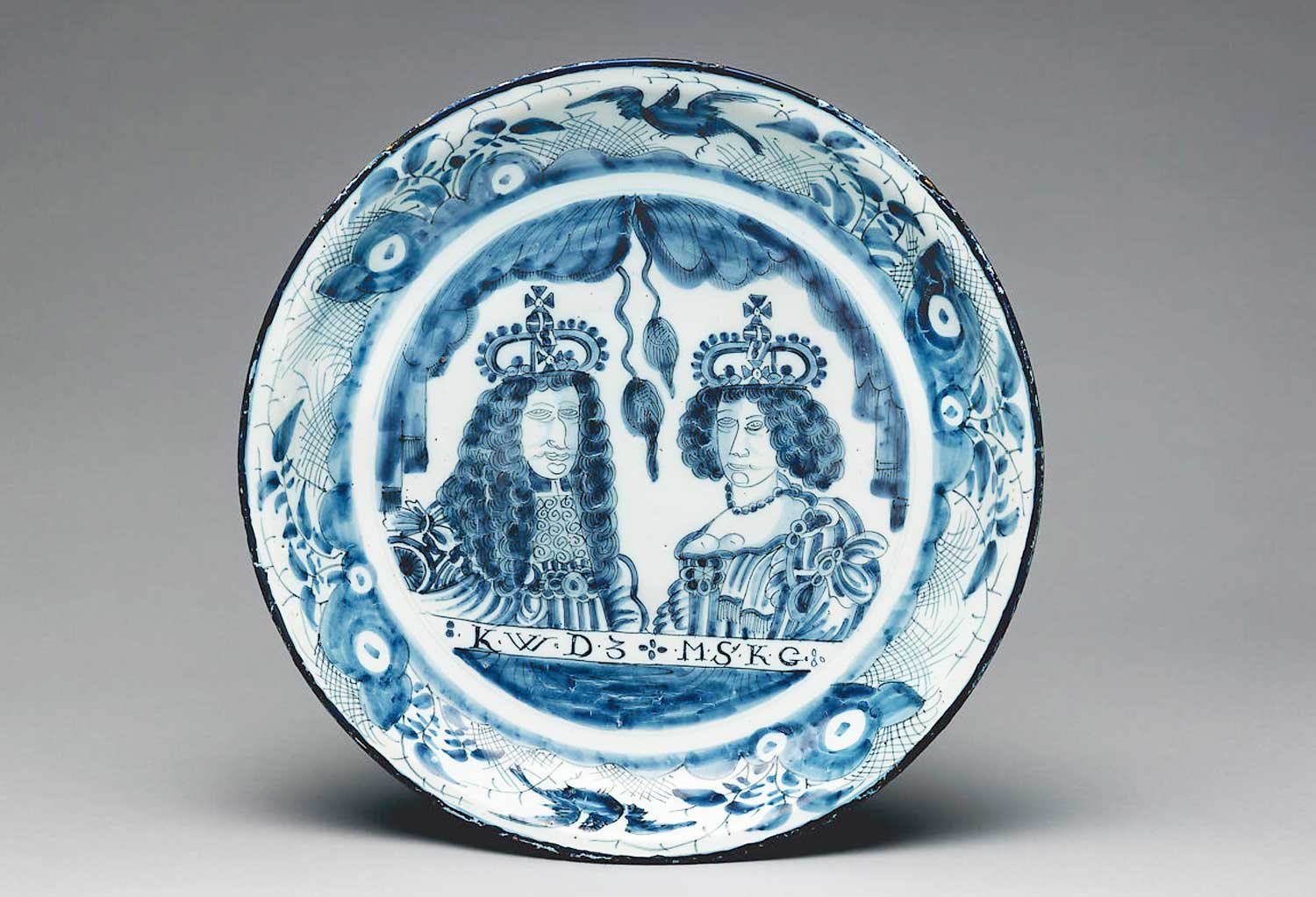
William III and Mary II, 1690. Dutch Delftware. Met Museum.
Note the Chinese motifs on the cavetto that surround the double-portrait. This is Dutch, not English, although I would still argue the style of the King and Queen are a bit whimsical, but the brushstrokes area a bit tighter.
English Delftware nevertheless developed its own character. Where Dutch potters were often meticulous in their imitation of Chinese motifs, English potters were more eclectic and sometimes charmingly naive. Alongside chinoiserie scenes and floral patterns, they painted something uniquely their own: portraits of kings, queens, and the great events of the age.
Royalty in Clay, A Commemorative Art
From the Restoration of Charles II in 1660 onwards, English potters found a ready market in royal commemorative ware. Mugs, plates, tiles, and posset pots were produced to mark coronations, royal birthdays, military victories, and just as often, political loyalties. In an era before mass printing, decorated pottery was one of the primary ways ordinary people displayed allegiance to the Crown.
The portraits that emerged from these workshops are remarkable objects. Painted with quick, confident brushstrokes, they are not technically accomplished in the way a court miniature might be but they have an immediacy and directness that court painting rarely achieves. The monarchs who appear on Lambeth dishes and Bristol plates are recognisably human: sometimes flatteringly rendered, sometimes stiff and slightly awkward, always full of character.
I love the style!
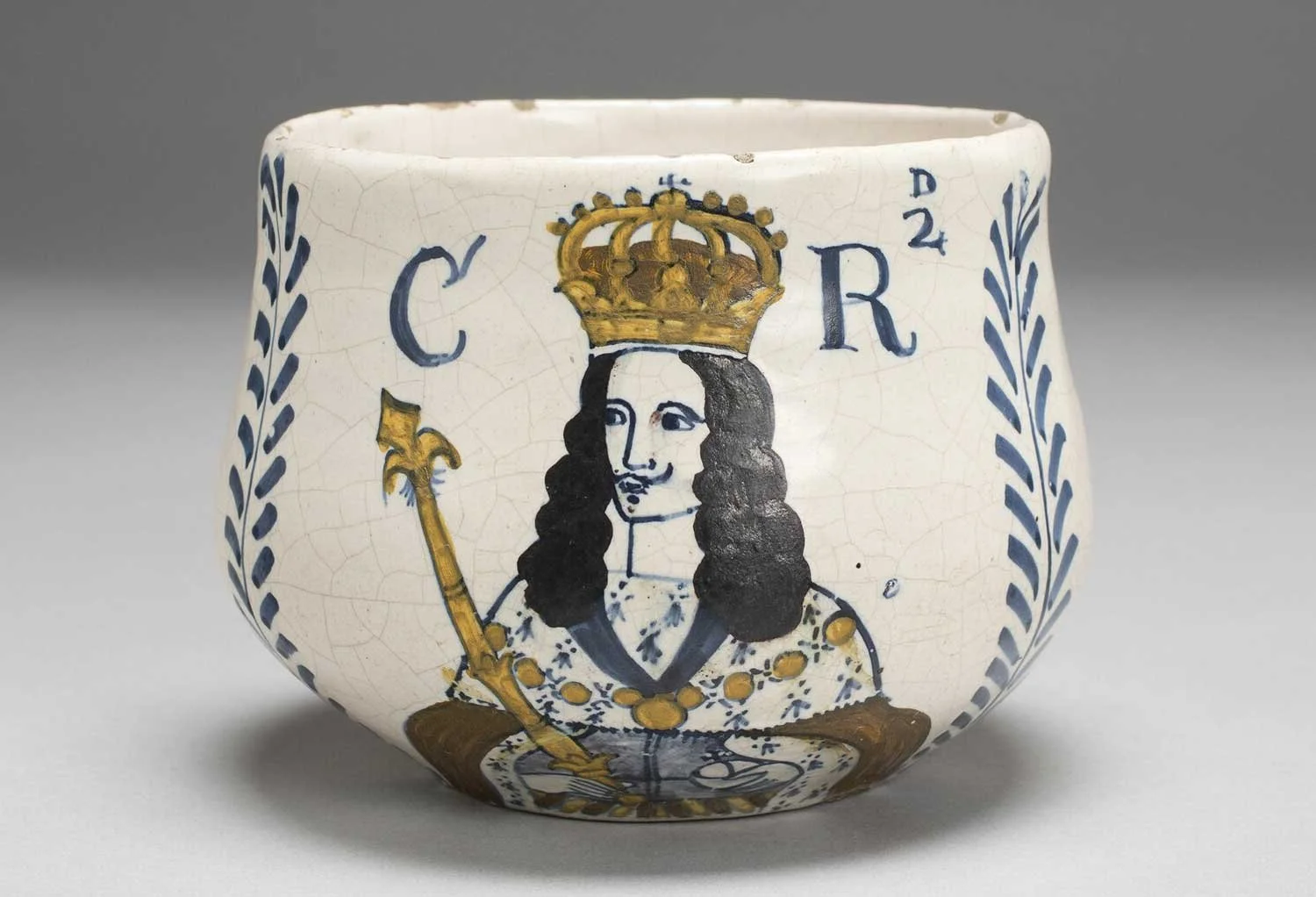
King Charles II, ‘CR’ for Carolus Rex. 1668 Caudle Cup, Art Institute of Chicago.
The monarchs most depicted
Charles II was perhaps the single most celebrated figure in seventeenth-century English pottery. His restoration after the Interregnum was greeted with an outpouring of decorative objects, and his distinctive features and long, flowing periwig were reproduced on hundreds of dishes, cups and chargers. Many were made as presentation pieces; others were simply tokens of popular joy.
A Caudle Cup, according to the Art Institute of Chicago, held a warm beverage containing a mixture of eggs, bread, oats, mulled ale or wine, milk, and spices. This cup does not have handles, most caudle cups have 2 handles and sometimes a cover.
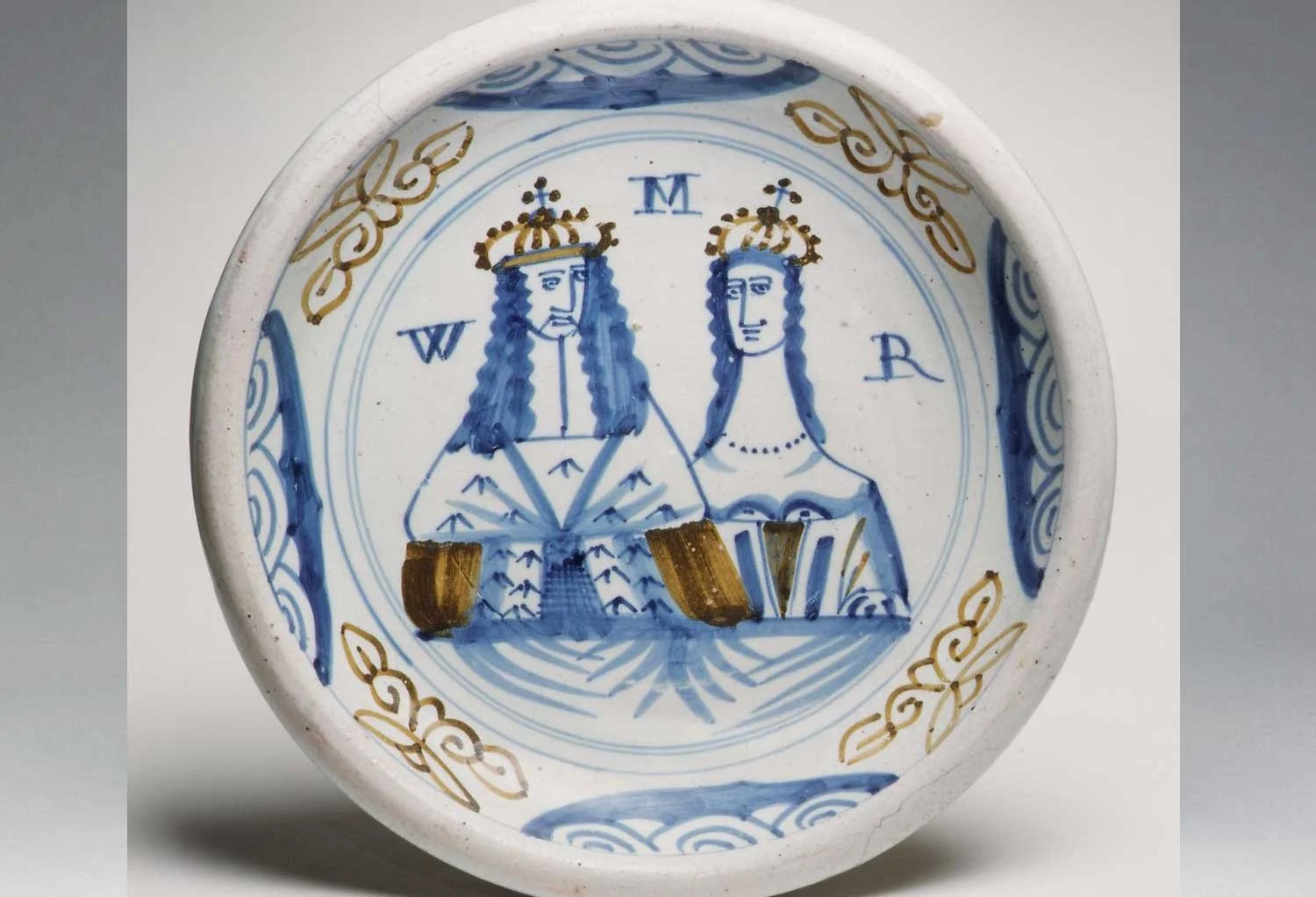
William and Mary, 1690, probably Lambeth potters. Met Museum.
William III and Mary II inspired their own wave of commemorative ware after the Glorious Revolution of 1688. Their joint kingship was unusual and potters seem to have relished depicting them side by side, often framed by laurel wreaths and inscriptions proclaiming Protestant triumph. William alone was also frequently depicted, particularly in martial guise after his victory at the Battle of the Boyne.
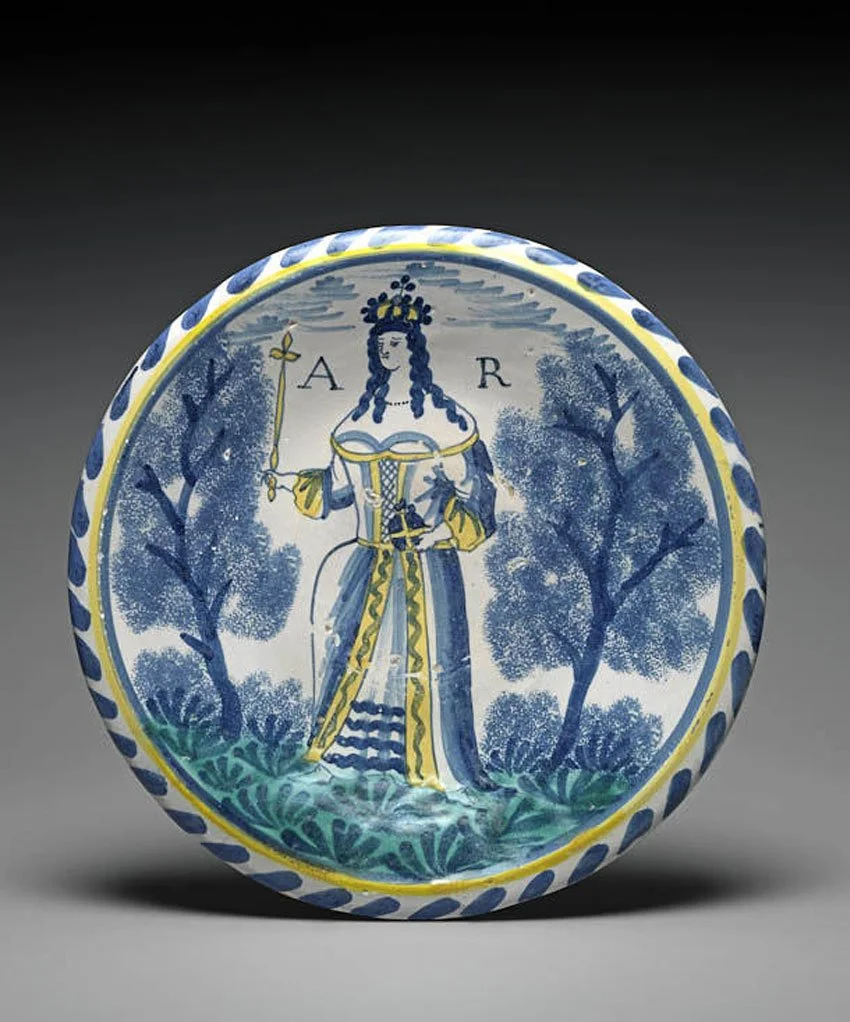
Queen Anne, 18th c, English Delftware Photo: the Fitzwilliam Museum, Cambridge UK
Queen Anne, the last Stuart monarch, appeared on pottery made during and after her reign, often paired with symbolic references to the Act of Union of 1707. The early eighteenth century also saw increased production of pieces celebrating the Hanoverian succession — George I and George II both appear, though with less frequency than their Stuart predecessors.
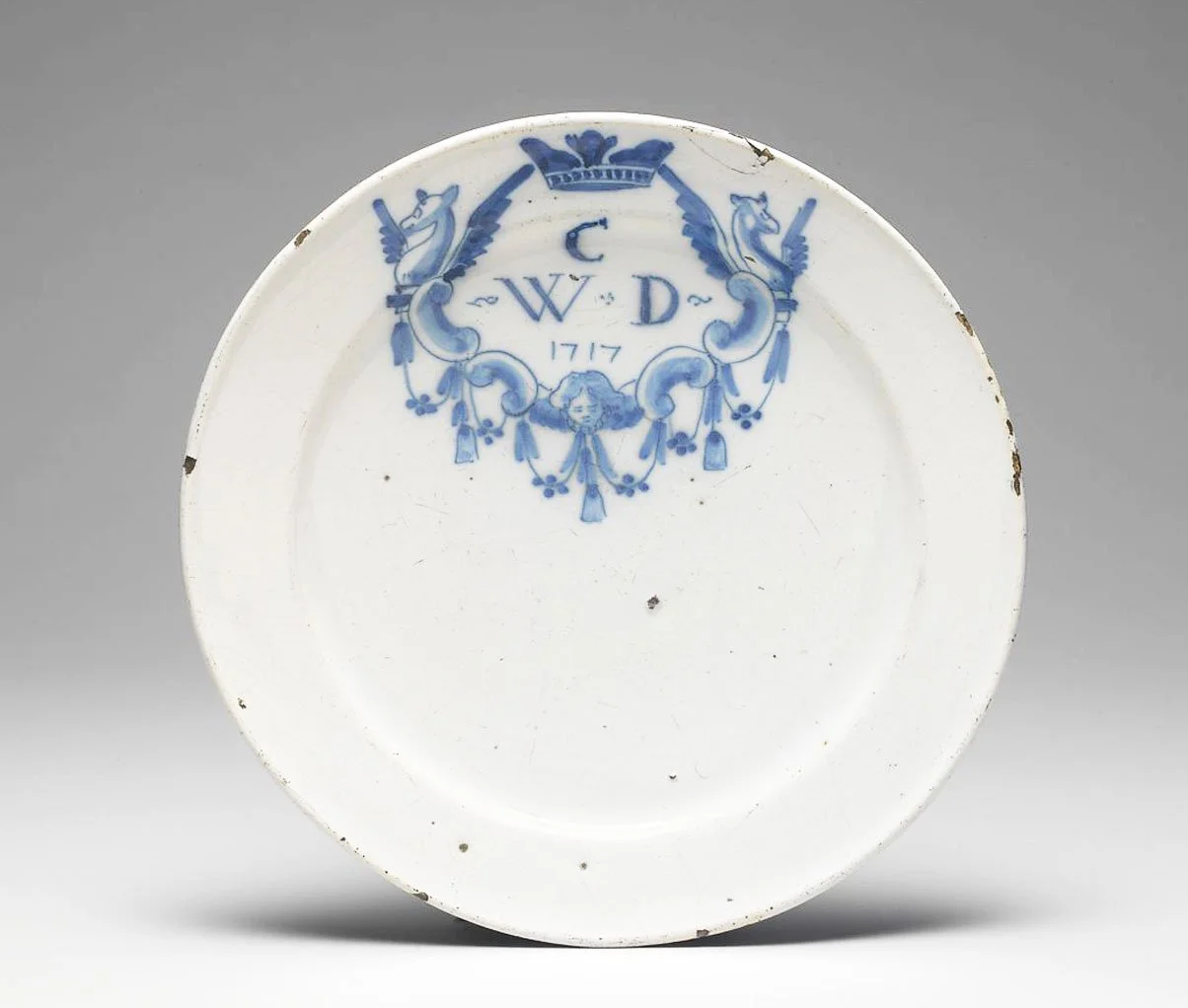
Tin-glazed Lambeth plate with monogram. 1717, Met Museum.
Reading a piece: what to look for
When examining a tin-glazed royal piece, several features require close attention. The ground colour and whether the white is creamy or blue-tinged can help narrow down the workshop and period. Lambeth wares often have a slightly blue-white ground; Bristol tends toward a warmer ivory.
The inscription, where present, is often the most historically valuable element. Royal pieces frequently carry a date, a name, or a loyalist motto - evidence of the exact occasion that prompted their making. Even the lettering style can suggest a region; London workshops favoured a rather formal italic script, while provincial potters were often more idiosyncratic.
Legacy and survival
By the 1780s, the age of English Delftware was effectively over. Josiah Wedgwood's creamware which was lighter, more uniform, and less prone to chipping, swept the market, and the Lambeth and Bristol potteries gradually closed or converted. Tin-glazed earthenware survived in other European traditions, but in England it was gone, leaving behind a body of objects that now feel like despatches from a very particular world: loyal, colourful, and gloriously imperfect.
The pieces that survive - and there are thousands in museums and private collections alike - are not simply decorative objects. They are documents of popular political culture, evidence of how ordinary people in seventeenth and eighteenth-century England understood and expressed their relationship to the Crown. In their rough brushstrokes and determined inscriptions, they carry a kind of unguarded historical truth that more polished media rarely achieves.